 TrainNotes
Workouts, work sets and volume
How much training did you complete?
What it shows
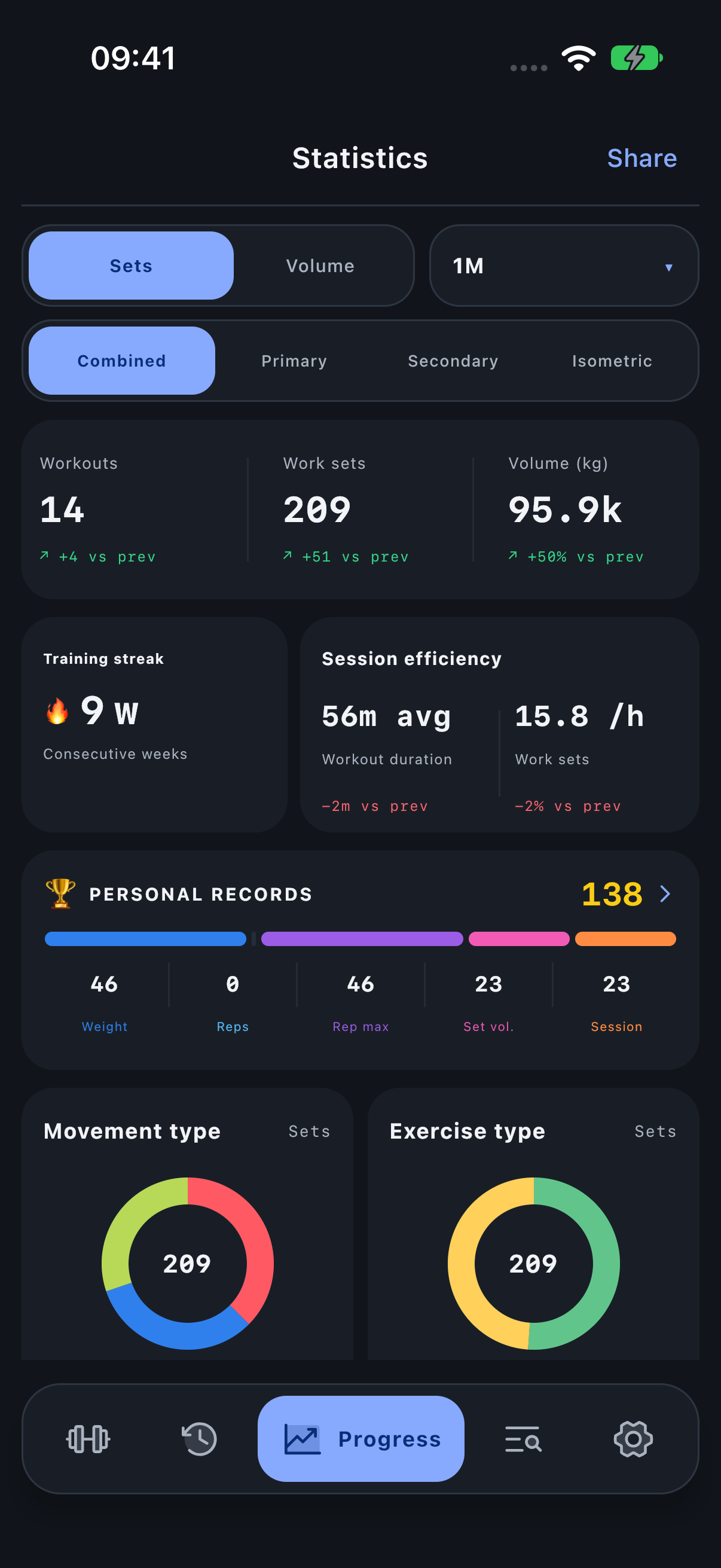
Workouts counts finished sessions in this scope. Work sets shows role-weighted completed working-set contribution. Volume sums effective load × successful reps with the same role weighting where the tracking schema supports it. Warm-ups do not enter these working totals.
How to read it
Read the three values together. More workouts with unchanged sets may mean shorter sessions. More volume with unchanged sets can come from higher weight, more reps, different equipment or a combination.
In Primary, four sets of 50 kg × 10 contribute 2,000 kg of volume. Four sets of 50 kg × 12 contribute 2,400 kg: 20% more volume with the same set count. This is a measure of recorded load, not a measurement of training quality.
Period, units and filters
Use the selected period and scope. A muscle-role selection changes both qualifying work and the contribution weight. Primary uses 1.0, Secondary 0.5 and Isometric 0.25; Combined adds the qualifying roles. These are contribution totals, which can differ from the raw number of completed rows in a session. The arrow or difference below a value compares it with the preceding equal-length period.
Investigate the result
Scroll to Session efficiency for duration context, or use Movement × exercise type to see which kinds of work contributed.
Open Progress → Statistics and scroll to the named module.