 TrainNotes
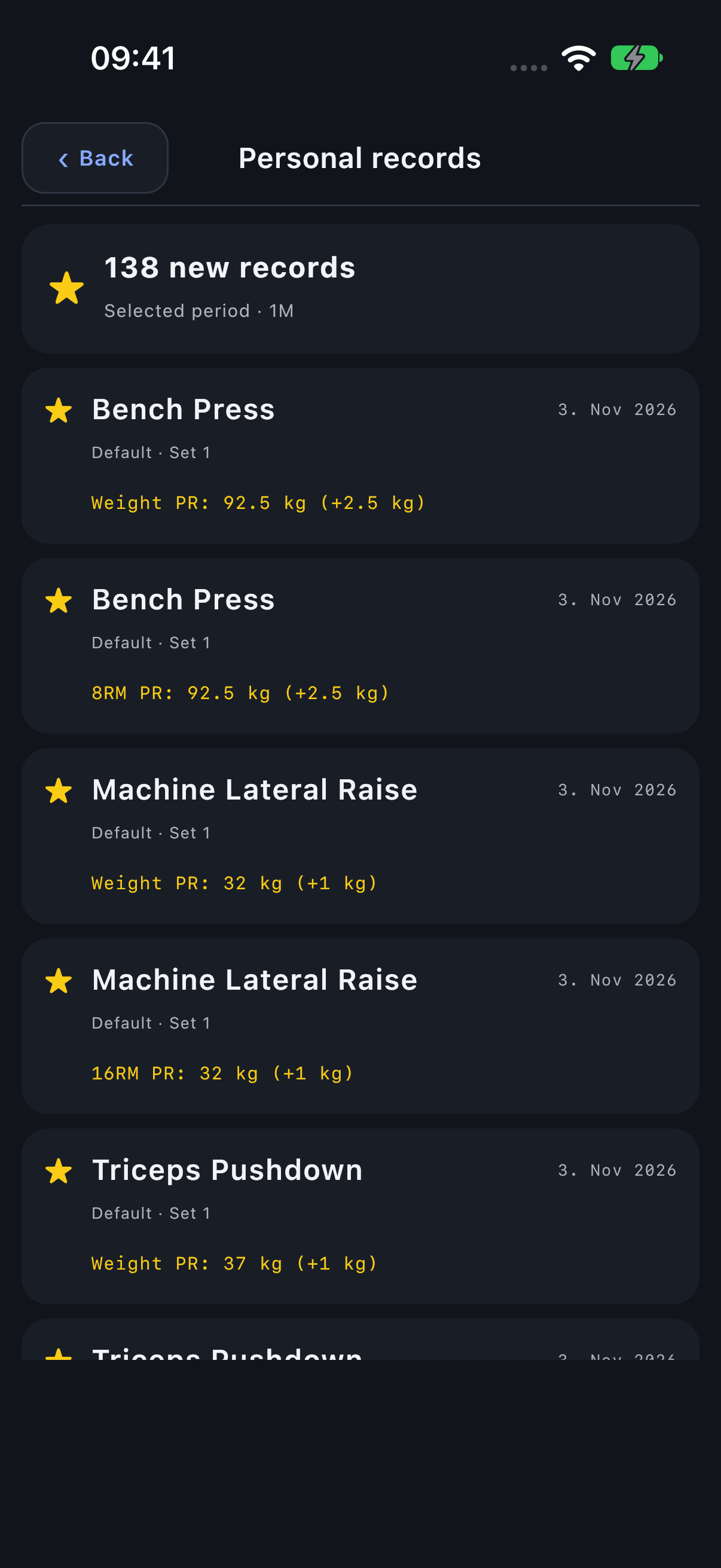
Personal records
Which performances exceeded your earlier results?
What it shows
The overview counts record achievements in five categories: Weight, Reps, rep-max, best set volume and best session volume. One set may achieve several categories, so the overview total is not the number of record-breaking sets.
Distinguish the five record categories
- Weight: a heavier successful working-set load for the Variant.
- Reps: more successful reps than before at the same or a heavier effective load.
- Rep-max: the best recorded load for that many reps, compared against earlier sets with at least that rep count. It is not the estimated 1RM formula.
- Best set volume: a higher load × reps result in one working set.
- Best session volume: a higher sum of completed working-set volume for one Variant in one workout.
The first successful result can establish a baseline record. Later achievements must be strictly better. An ordinary failed extra attempt adds no successful rep.
How to read it
Tap Personal records to open the dated list. Read the Exercise, Variant, category, result and improvement together. Equal results are not new PRs. Warm-ups and unsuccessful reps do not create successful lifting records.
After 17 reps at 79 kg, 17 at 78 kg is not a Rep PR. After an earlier 80 kg × 8 on one machine Variant, a different machine gets its own record history rather than borrowing that baseline.
Period, units and filters
The period chooses when an achievement occurred. Comparison still uses earlier history for the same Variant, including history before the period. Changing to 1M does not reset your records at the start of that window.
Investigate the result
Review the actual set in History or open the Variant progress ledger to understand the result behind the star.
Open Progress → Statistics and scroll to the named module.